← Back to All Solutions

Solutions

Environmental Control Systems (ECS)

GT-SUITE’s comprehensive library of thermal and fluid templates empowers users to quickly create ECS models

Solution Overview

Full-System ECS Modeling

GT-SUITE gives engineering teams a single environment to design, validate, and optimize aircraft environmental control systems, from early concept trade-offs through detailed component sizing and scenario testing. Modeling the full system rather than isolated components helps teams evaluate design decisions faster and catch cross-system risks earlier in the program.

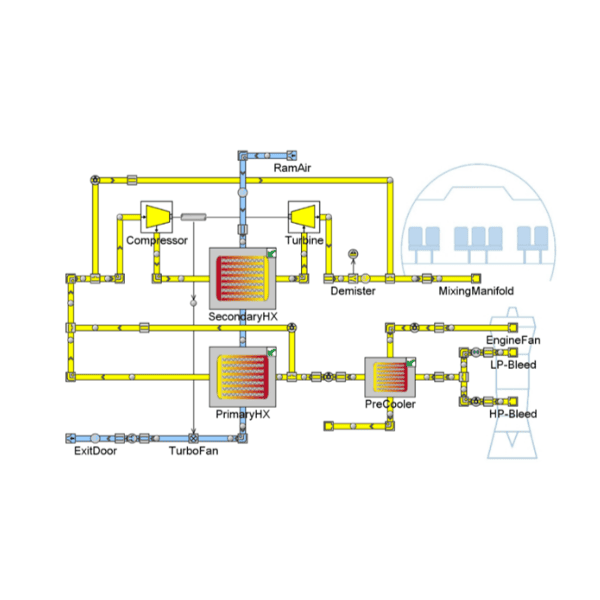
The platform supports full system simulation of ECS, covering air cycle machines (ACM), refrigerant vapor-compression loops, air supply ducting, pressurization, humidity control, and cabin thermal management. Subsystem cooling, including avionics, fuel systems, gearboxes, and transmissions, can also be modeled within the same environment. Both steady-state and transient analyses are readily configured to evaluate scenarios such as take-off under arbitrary ambient conditions, worst-case loading, and standard duty-cycle operation. A comprehensive thermal and fluid template library enables rapid model construction, with flexible fidelity across components such as heat exchangers, valves, and pipes.

Built-in DOE and optimization tools support component sizing, system layout, and control strategy development. Integrated 3D tools allow direct conversion of CAD data into 1D piping networks or 3D cabin models for comfort analysis. GT-SUITE’s multi-physics libraries, spanning mechanical, electrical, magnetic, chemistry, and controls, also allow ECS models to be fully integrated with other physical systems to study cross-domain interactions.

Application Highlights

Automated ECS Modeling

  • Automatically create a 1D flow system model from 3D CAD for the complete ECS system, including air distribution, liquid circuits, and thermal masses.
  • Automatically mesh heat exchangers, fans, and air space using integrated 3D tools.
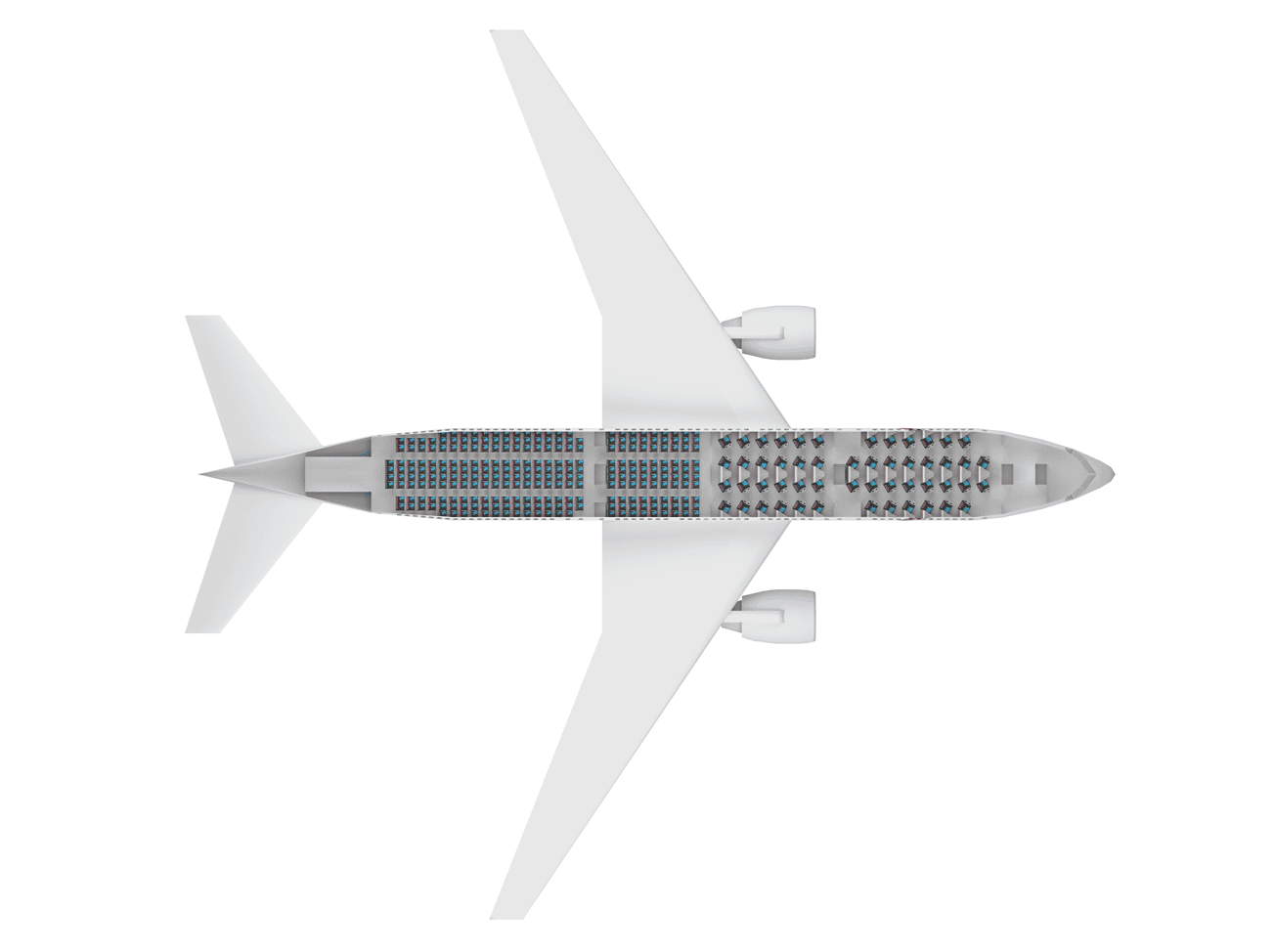
  • Get temperature, humidity, and airflow results at any location in the cabin for detailed comfort analysis.
  • Model air cycle or vapor-compression cycle (two-phase flow) systems within the same environment, with stable solutions even under dynamic control.
  • Build models faster using validated templates for turbines, compressors, heat exchangers, valves, and more.
  • Model heat exchangers at the fidelity you need, from simple representations for early studies to fully detailed models.
  • Run fully transient solutions by default, capturing air transport, pressurization, humidity tracking, and heat transfer.
  • Automatically account for water vaporization and condensation without manual switching between phase states.
  • Change models easily thanks to a fully parametric structure.
  • Base flow solutions on Navier-Stokes equations for robust, stable results.
  • Solve the energy equation by default for accurate thermo-hydraulics.

Advanced Features

Advanced Environmental Control System Simulation

Optimize ECS performance, comfort, and system interactions with advanced simulation tools.

check mark icon

Human Comfort and Thermal Co-Simulation

Couple GT-SUITE with TAITherm to model the interaction between ECS performance and the human body, delivering precise cabin comfort predictions under real operating conditions. This integration enables engineers to evaluate occupant thermal experience alongside system-level energy consumption in a single workflow.

check mark icon

Open Co-Simulation Architecture

Connect GT-SUITE with virtually any commercial or in-house software to extend your simulation environment without boundaries. Whether integrating controls, structural, or CFD tools, GT-SUITE's open co-simulation framework ensures your ECS model fits seamlessly into any engineering workflow.

check mark icon

Built-In Optimization and DOE

Accelerate design decisions with integrated Design of Experiments and optimization tools that operate at any level, from individual component sizing to full-system energy consumption. No external tools or manual iteration loops are required.

Connect with an Expert

Looking for guidance on a systems simulation challenge or project? Fill out the form below and our team will reach out to discuss how we can help.