





← Back to All Solutions

Solutions

Cabin Comfort

GT-SUITE offers simulation solutions that model and optimize cabins to satisfy comfort requirements and operational temperature constraints

Solution Overview

Integrated Cabin Models for Thermal and HVAC Analysis

Creating a comfortable environment while minimizing energy consumption is a challenge for designers across many industries. Engineers need to understand how HVAC systems, climate conditions, and thermal loads interact to influence occupant comfort and system performance. 

GT-SUITE covers the full design process, from early-phase HVAC sizing and compressor control strategy evaluation to detailed occupant thermal comfort prediction, supported by a full range of 0D to 3D models. For high-fidelity comfort assessment, GT-SUITE co-simulates with GT-TAITherm, which models radiation and solar effects while a human thermal manikin model quantifies occupant comfort at a physiological level. Fast model run times enable hardware-in-the-loop integration and controls calibration. Intuitive workflows and AI-assisted design exploration help engineers evaluate more concepts and gain faster insight into the factors that affect comfort, efficiency, and energy consumption. The result is a streamlined development process that reduces time and cost while delivering comfortable, energy-efficient products. 

Comprehensive, Easy-To-Use Solution

  • Comprehensive and intuitive environment for developing, calibrating, and analyzing cabin thermal and HVAC models across a wide range of applications 
  • Enables engineers to quickly create models at the appropriate level of detail, from simplified system-level representations to detailed zonal and CFD-based analyses
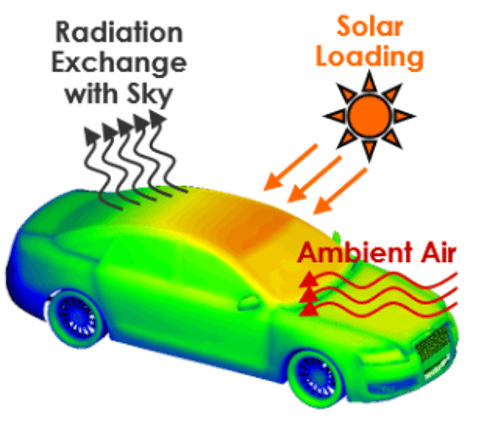
  • Represents the cabin as a dynamic thermal load, capturing the effects of occupants, solar radiation, ambient conditions, materials, and heat transfer on HVAC system demand  

Co-Simulation with GT-TAITHERM

  • GT-SUITE integrates ThermoAnalytics’ industry-leading 3D thermal and comfort analysis tool, TAITherm, as GT-TAITherm, providing a seamless workflow for detailed cabin thermal modeling within the GT-SUITE environment.  
  • Physics-based models capture the effects of conduction, convection, radiation, transient solar loading, and occupant interactions on cabin thermal behavior and comfort.  
  • Enables real-time capable 3D cabin comfort models that can be used independently or integrated with system-level HVAC and thermal models to support design evaluation, optimization, and controls development. 

Application Highlights

High-Fidelity 3D Cabin Modeling

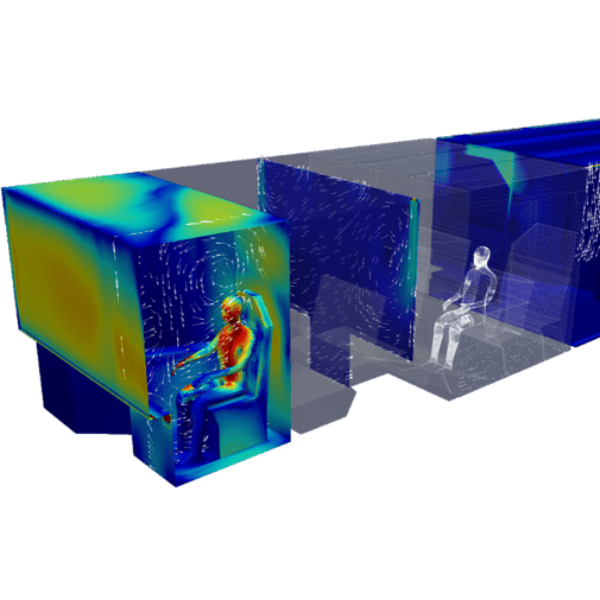
  • Integrated 3D CFD tools, including GT-Auto-3DFlow and GT-CONVERGE, deliver advanced airflow and thermal simulation capabilities in a fast, flexible, and easy-to-use environment.  
  • Enables seamless coupling between detailed 3D airflow models and HVAC system components, providing a comprehensive view of thermal performance, occupant comfort, and system behavior.  
  • Combines high-fidelity CFD analysis with model order reduction workflows, empowering engineers to develop fast-running models that accelerate design optimization, controls development, and virtual testing. 

Advanced Features

Advanced Cabin Comfort Capabilities

GT-SUITE enables cabin comfort simulation for automotive, aircraft, and commercial vehicles, helping optimize HVAC performance and occupant comfort.

check mark icon

Develop Next Generation HVAC Control Solutions

Next-generation climate control systems combine multiple HVAC subsystems, localized comfort features such as heated seats and radiant panels, and personalized occupant zones. GT-SUITE predicts cabin temperature distributions and occupant thermal comfort metrics at or near real-time speeds, enabling the development of comfort-aware climate control strategies. Engineers can evaluate the impact of localized comfort technologies on both occupant comfort and overall energy consumption, helping optimize efficiency without compromising comfort.


check mark icon

Thermal System Integration

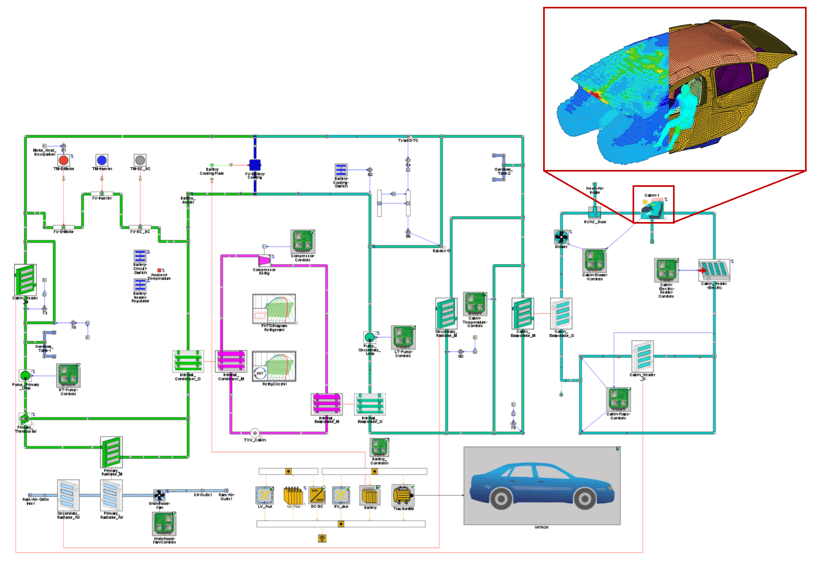
GT-SUITE seamlessly connects 3D cabin models with broader vehicle thermal systems, including HVAC air circuits, vehicle cooling systems, battery thermal management systems, and powertrain thermal models. This integrated approach enables engineers to evaluate interactions between cabin comfort, thermal loads, energy consumption, and overall vehicle performance within a single simulation environment.

check mark icon

TAITherm 3D Comfort Simulation

When co-simulating with GT-TAITherm, leverage TAITherm's built-in thermal manikin model to predict occupant thermal comfort with high spatial resolution. This provides physiologically accurate comfort assessments that go beyond simple air temperature metrics.

check mark icon

Industry Leading Comfort Simulations

GT-TAITherm’s industry leading manikin model allows for accurate prediction of occupant thermal sensation and comfort with comfort metrics like Equivalent Homogenous Temperature (EHT) and Berkeley Sensation and Comfort. This provides physiologically accurate comfort assessments that go beyond simple air temperature metrics.

check mark icon

Multi-Platform Cabin Design

Model and analyze cabins for automotive, aircraft, and other vehicle platforms within a single, unified simulation environment. GT-SUITE's flexible cabin architecture supports diverse geometries and boundary conditions, reducing the need for platform-specific toolchains.

check mark icon

Extend CFD data with Flow Field Mapping

Import pre-computed 3D CFD flow fields to create fast-running fluid models when higher spatial fidelity is required. Flow Field Mapping enables engineers to leverage detailed CFD results within transient system simulations, combining high-resolution airflow predictions with real-time capable performance. This approach supports controller development, design optimization, and virtual testing without the computational cost of running CFD throughout the simulation.

check mark icon

Multi-Platform Cabin Design

Model and analyze thermal comfort and HVAC performance for automotive, aerospace, off-highway, and other vehicle applications within a unified simulation environment. GT-SUITE's flexible cabin modeling architecture supports a wide range of geometries, operating conditions, and thermal boundary conditions, reducing the need for platform-specific workflows and tools.

check mark icon

Real-Time Drive Cycle Simulation

Simulate complete vehicle drive cycles, including standard regulatory cycles such as NEDC and WLTP, at or near real-time speeds to evaluate cabin and HVAC performance under representative operating conditions. This capability supports controls development, hardware-in-the-loop testing, and BEV range analysis by accurately capturing the interaction between thermal loads, climate control systems, and vehicle energy consumption.

Cabin Comfort FAQs

Frequently asked questions about cabin comfort simulation and HVAC optimization in GT-SUITE.

Connect with an Expert

Looking for guidance on a systems simulation challenge or project? Fill out the form below and our team will reach out to discuss how we can help.