← Back to All Products

Products

Protected: Scientific AI meets Physics

Train AI models from trusted GT-SUITE simulations and embed them directly into your system models. Accelerate simulation speed by replacing computationally intensive components with physics-informed metamodels while maintaining the accuracy needed for engineering decisions.

Fusion of Physics and ML

AI-accelerated simulation​

Merge ML and physics into one single model​

Engineering teams are under constant pressure to evaluate more design concepts, explore larger design spaces, and deliver results faster.

GT-SUITE’s Machine Learning Assistant (MLA) enables engineers to create AI-powered metamodels from high-fidelity simulation data and seamlessly integrate them into physics-based models​. The result is significantly faster simulations without sacrificing the physics foundation that gives engineers confidence in their results.

Whether you’re developing battery-electric vehicles, thermal systems, fuel cells, or complex multiphysics models, MLA helps you unlock faster engineering workflows and accelerate innovation.

AdobeStock_845057742_2

See It Before You Commit

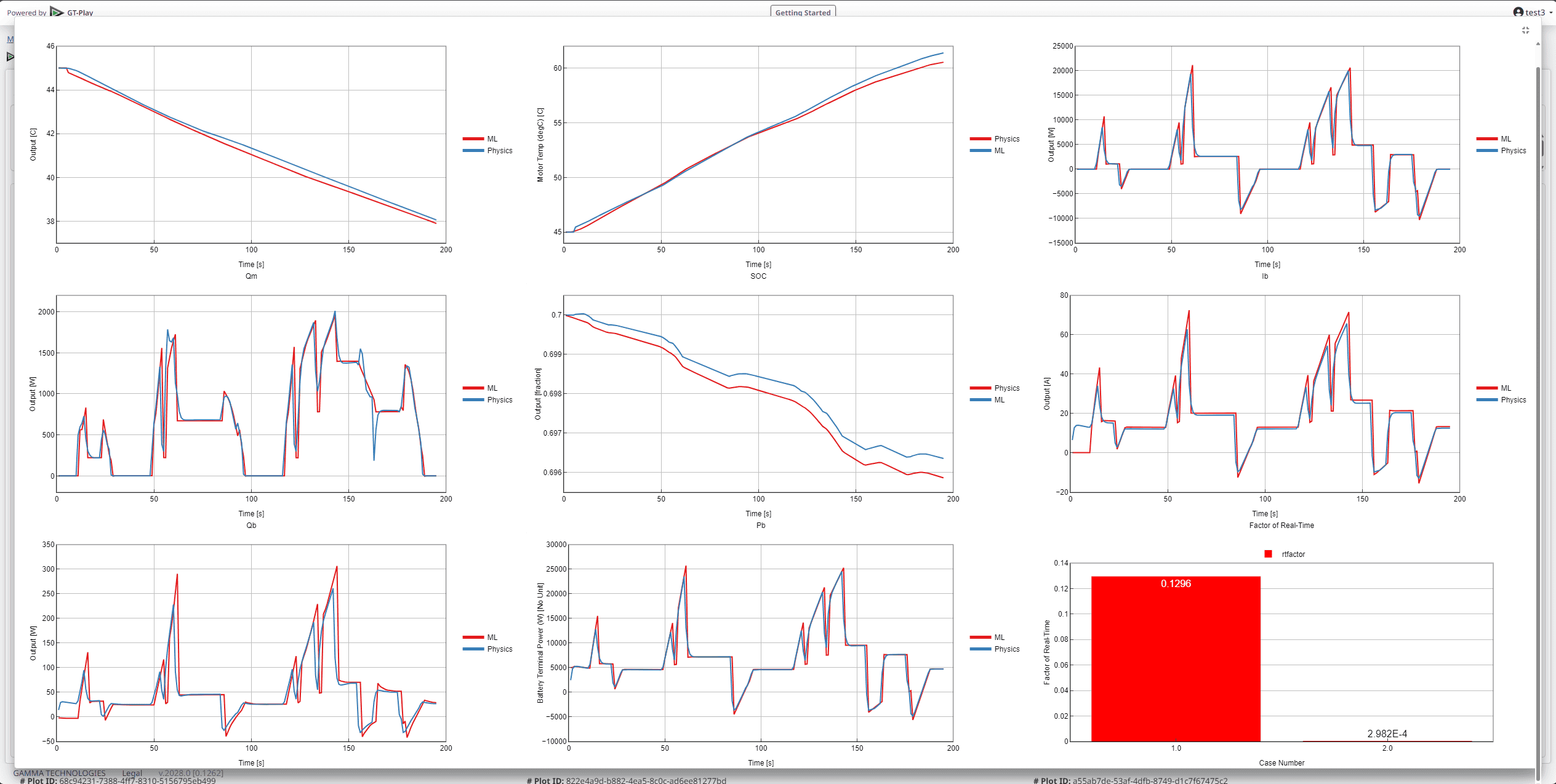
Don’t just read about AI-accelerated simulation. Experience it. Through an interactive GT-Play demonstrator, you can run and compare physics-based and ML-enhanced versions of the same model directly in your browser. See how metamodels can deliver significant speed improvements while staying grounded in trusted engineering physics.

Try it now. No downloads required.

image (19)
resultsFull

Seamless Physics Integration

Metamodels are not separate from your system model. They become part of it. Engineers can choose from multiple deployment approaches depending on the application and simulation objectives.

Metamodel Harness

The Metamodel Harness allows a trained machine learning model to be integrated into an existing GT-SUITE system model. Replace a computationally expensive subsystem with a metamodel while preserving interactions with the surrounding physics-based model.

Benefits:

  • Faster system simulations
  • Minimal model restructuring
  • Preserved system-level behavior
  • Ideal for digital twins and large-scale simulations

Metamodel Reference Objects

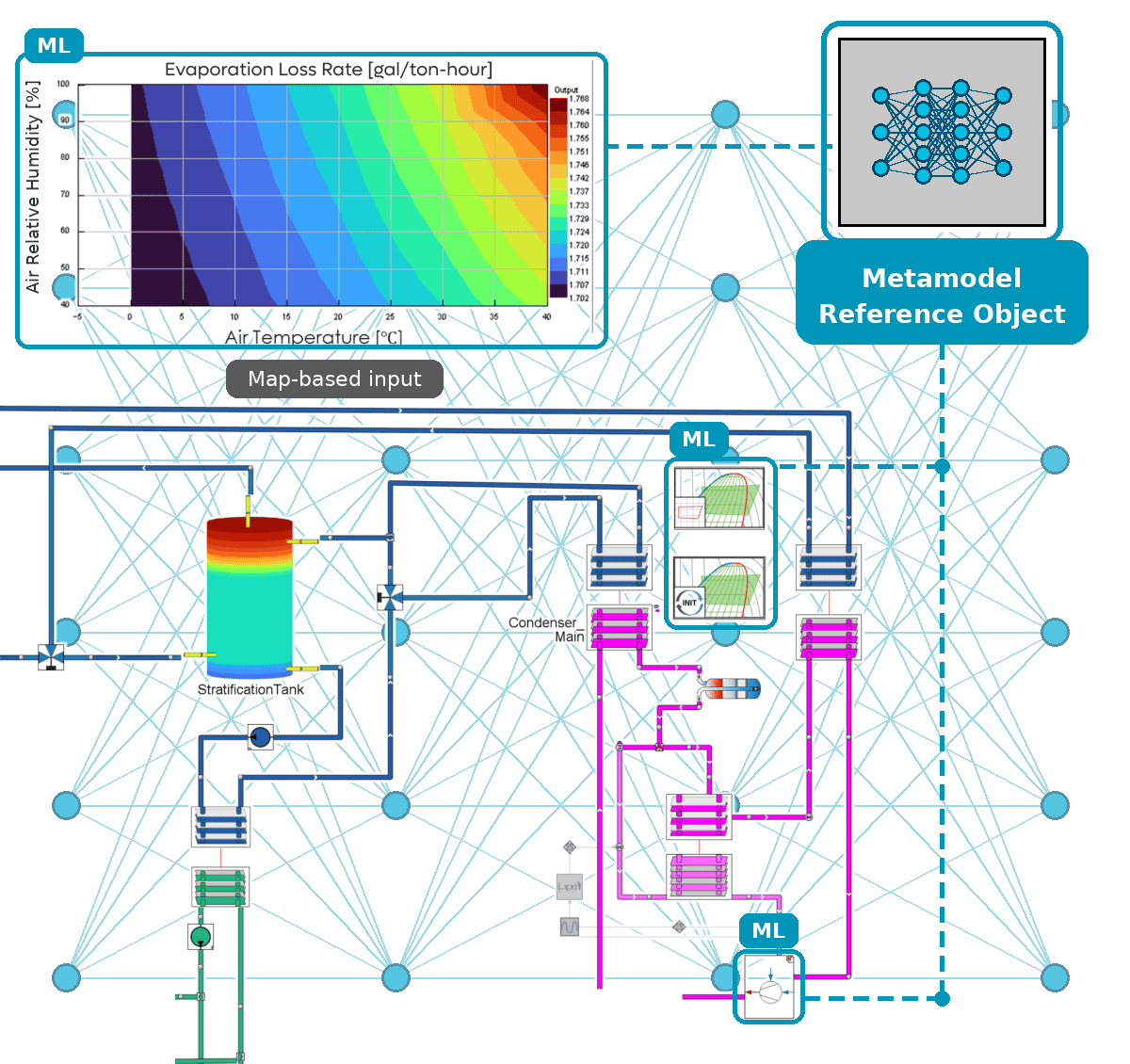
Metamodel Reference Objects can be embedded directly into component and solver templates, making them reusable throughout your model library. This approach can enhance accuracy compared to traditional lookup tables while delivering significant speed improvements compared to full physics solvers.

Benefits:

  • Improved accuracy compared to conventional lookup tables
  • Faster execution than equivalent physics-based solvers
  • Reusable across multiple models and projects
  • Direct integration into GT-SUITE component and solver templates
  • No model restructuring required


metamodel_reference_object_v3

How It Works

From Physics-Based to ML-accelerated simulations​

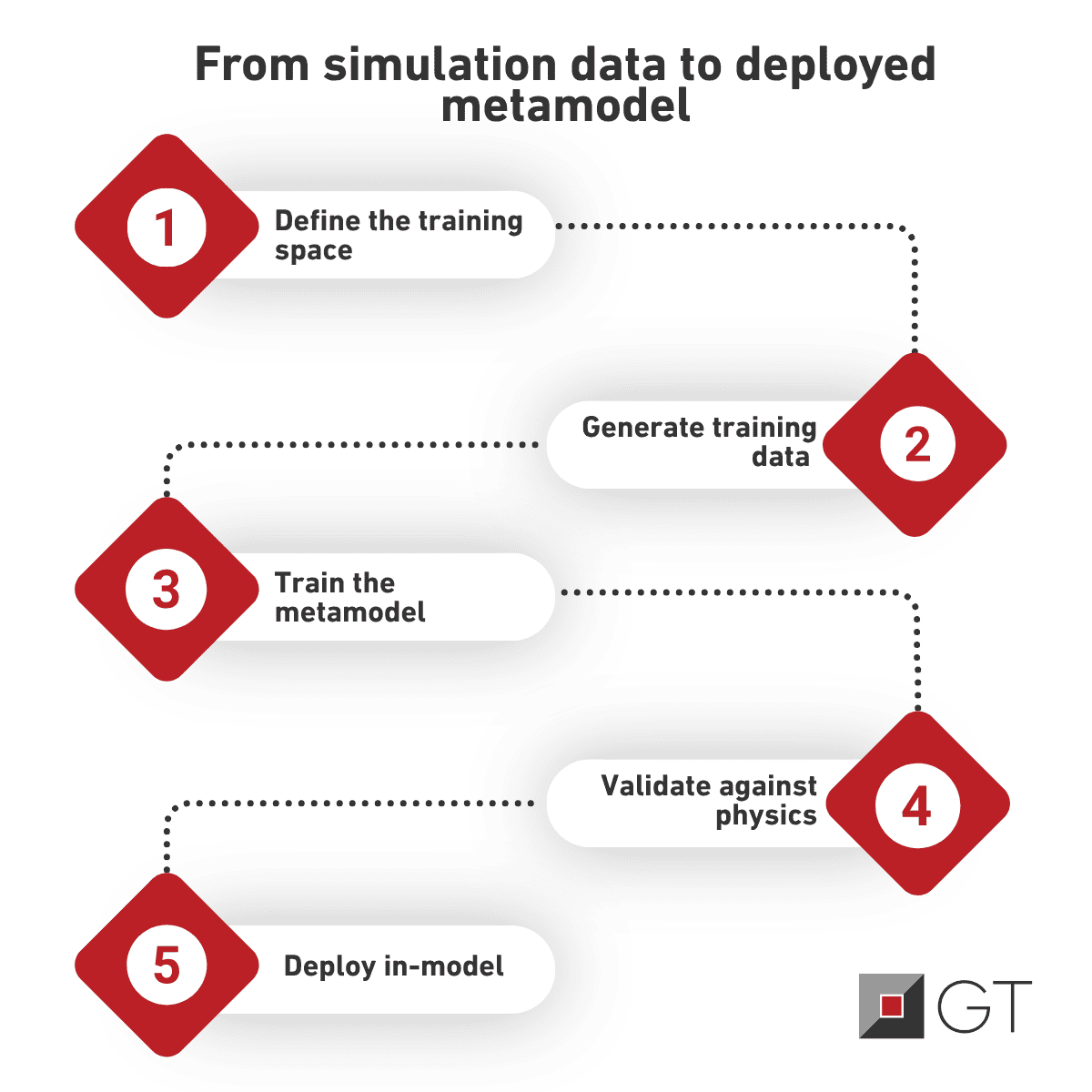
The Machine Learning Assistant guides users through the entire process of creating a simulation-ready metamodel.

  1. Define the training space. Specify input variables, their ranges, and the operating regimes that matter. MLA builds a design of experiments to cover the space efficiently.
  2. Generate training data. Run GT-SUITE physics simulations across the DOE. MLA manages execution and collects input–output pairs automatically.
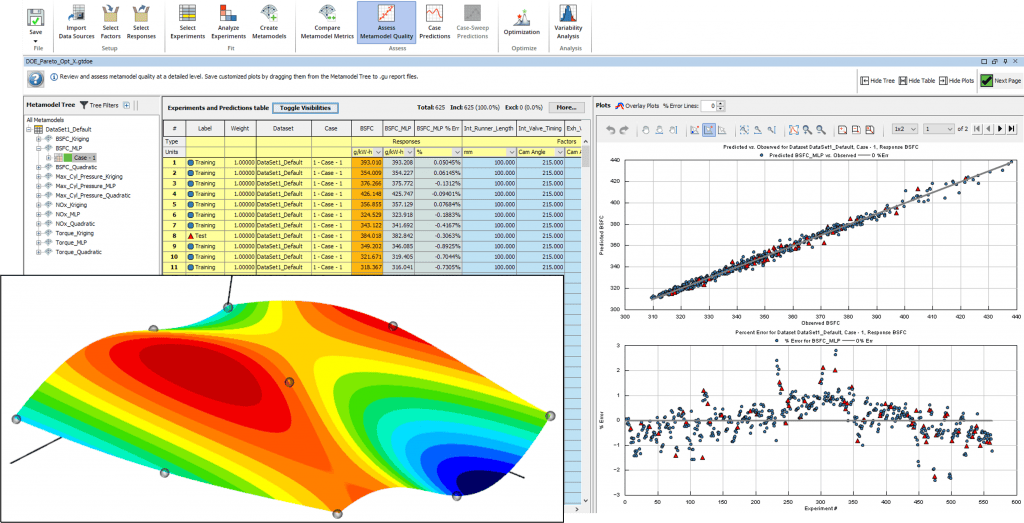
  3. Train the metamodel. Select a neural network architecture and train with cross-validation. Hyperparameter guidance is built in — no ML expertise required.
  4. Validate against physics. Automatically compare metamodel predictions to GT-SUITE reference runs. Accuracy reports flag any extrapolation risk before deployment.
  5. Deploy in-model. Export as a Harness or Reference Object. The metamodel becomes a solver component — live in your system model, ready for system-level simulation.
ML-and-DoE-1-1024×523-1-1

Use Cases

Scientific AI in Action

Three deployments where GT metamodels are already changing how engineering teams work — from digital twin co-simulation to fluid system replacement.

Battery Electric Vehicle Digital Twin

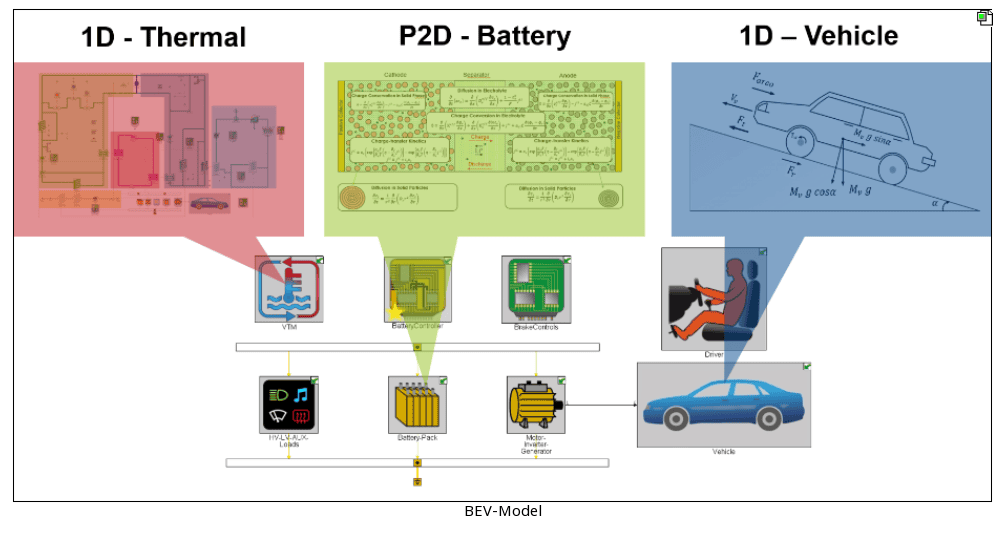
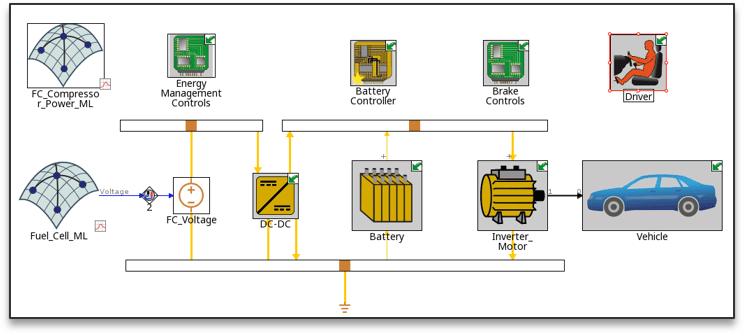
Battery-electric vehicle models often combine electrochemistry, thermal management, controls, and vehicle systems. By replacing computationally intensive battery models with trained metamodels, engineers can significantly accelerate simulation runtimes for digital twin and virtual development applications.

Air Conditioning Loop Acceleration

Detailed refrigeration cycle models provide valuable insight but can be time-consuming in large system simulations. Metamodels can represent key HVAC subsystem behavior while maintaining the fidelity needed for thermal management studies.

PEM Fuel Cell Metamodel Reference Object

The Fuel Cell Metamodel Reference Object enables engineers to represent stack behavior using machine learning models trained on detailed simulation data. This approach delivers highly efficient system-level fuel cell simulations.

Experience the Difference

Don't just read about AI-accelerated simulation. Try it. The GT-PLAY demonstrator allows you to run the same system model using both a traditional physics-based approach and an MLA-accelerated version. Compare simulation results and experience how Scientific AI can dramatically reduce runtime while maintaining engineering confidence.