







Blog
Inside the AI Factory, Part 2: Battery Integration and Grid Power Smoothing

Overview
Part 1 examined how volatile AI training and inference loads stress an 800 VDC data center’s electrical system and how millisecond-scale swings in rack power translate into voltage sag, current overshoot, and ripple across the bus. This post shifts focus to the battery backup unit (BBU), and to what that battery costs beyond its price tag.
Why add a battery backup unit to a data center architecture?
A battery backup unit (BBU) on the 800 VDC bus handles two things: it keeps the load running through a grid disturbance, and it evens out the sharp power swings AI workloads create before they hit the utility grid. Both are becoming harder to ignore. On the ride-through side, a transmission fault in Northern Virginia in July 2026 moved about 3,800 MW of data center load onto backup generation, the largest such event PJM has recorded, and PJM is now evaluating ride-through requirements for large computational loads. On the smoothing side, researchers at Microsoft, OpenAI, and NVIDIA have shown that synchronized training jobs across tens of thousands of GPUs produce large, repeating power swings that, if they line up with critical frequencies of utility equipment, can damage grid infrastructure (Power Stabilization for AI Training Datacenters).
Heron Power’s blueprint for 800 VDC data centers lays out a clear rationale for pairing a solid-state transformer with an integrated battery backup: a high C-rate battery, connected directly to the DC bus (no DC-DC converter in between), sized to deliver about 30 seconds of full-load backup power. That 30-second window matters because it’s roughly how long it takes backup generators to spin up during a grid disturbance. Beyond backup power, the same battery can also absorb the power swings created by AI workloads, smoothing what the utility grid actually sees.
Designing and sizing the battery backup unit
Following the same design logic Heron describes, the battery model was built from the ground up in GT-AutoLion. The cell pairs a lithium iron phosphate (LFP) cathode with a graphite anode, chosen for high power density: thin cathodes, thin anodes, thin separators, and small particle sizes, arriving at a 20 Ah prismatic cell design.
From there, pack sizing was driven by two hard requirements. Hitting 800 V (since the battery connects straight to the DC bus, with no converter) required 240 cells in series. Meeting the 30-second full-load backup requirement (while holding the bus inside a ±5 V window around nominal 800 V, the tolerance discussed in Part 1) required 40 cells in parallel.
Validating the battery design during a simulated outage
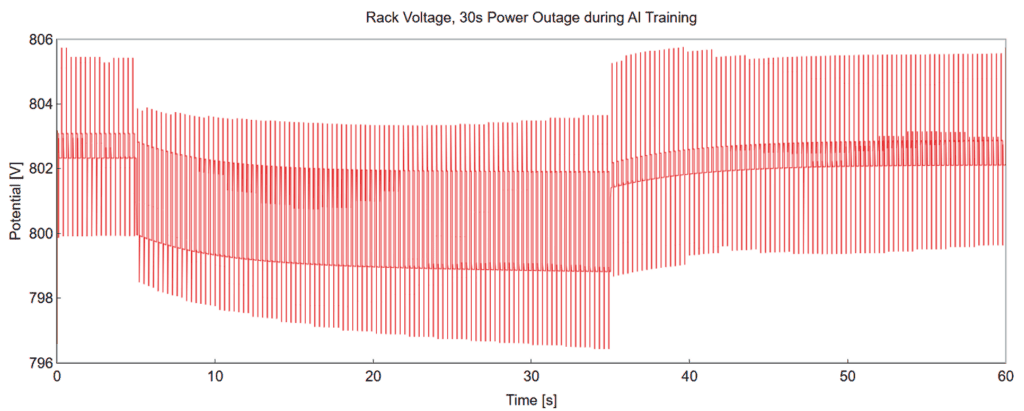
With the battery pack sized as described, the 800 VDC bus stayed comfortably within bounds during a simulated outage during a training event, confirming the 30-second backup window needed to bridge to generator startup, even during a power intensive AI training load.
Smoothing the grid: the visible benefit
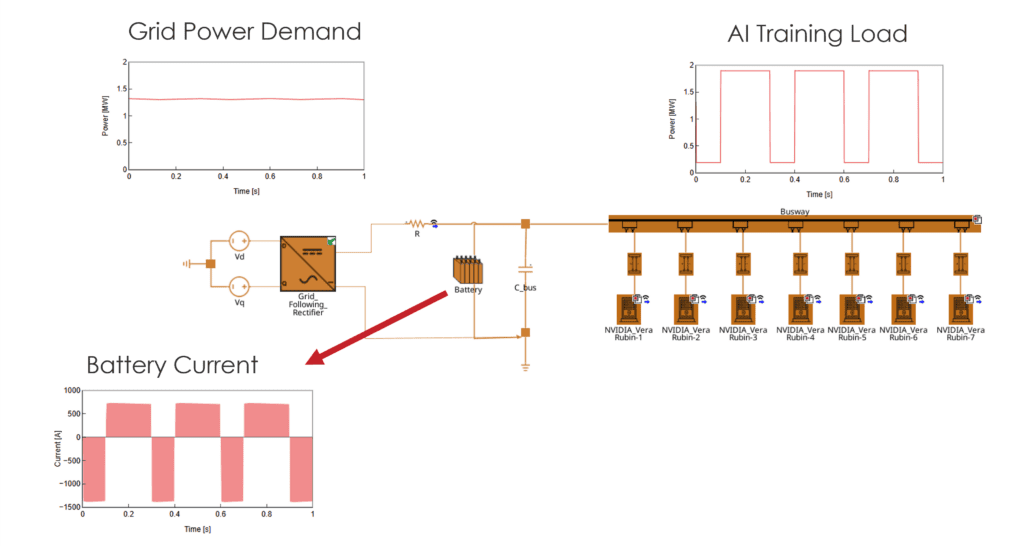
With the battery in place, two scenarios were compared under the same AI training load:
No power smoothing: the battery current holds near zero, and the very transient training load passes essentially straight through to the utility grid.
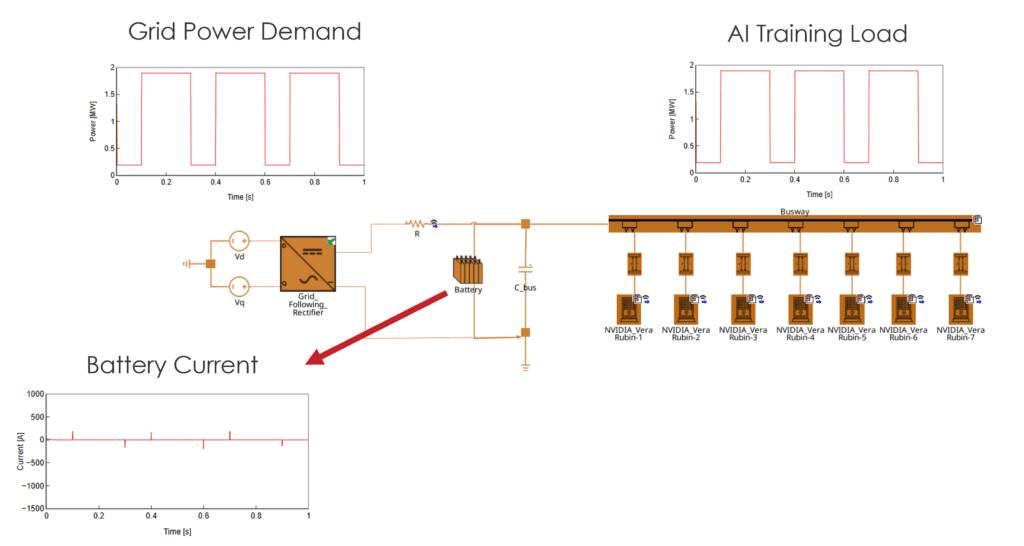
With power smoothing enabled: the battery actively switches between charging and discharging — at high current — to flatten what the grid sees. There’s still some residual fluctuation, largely due to the battery’s own internal impedance, but the difference is dramatic: a spiky, transient load on one side becomes a much smoother demand curve on the other.
This is the benefit data sheets and marketing materials for facility-level battery backup systems lead with. The next section covers what they leave out.
Hidden costs of battery backup unit: heating, degradation, and bus stability
Grid-side smoothing looks good in isolation, but getting it means pushing a lot of current through the battery, and that has consequences:
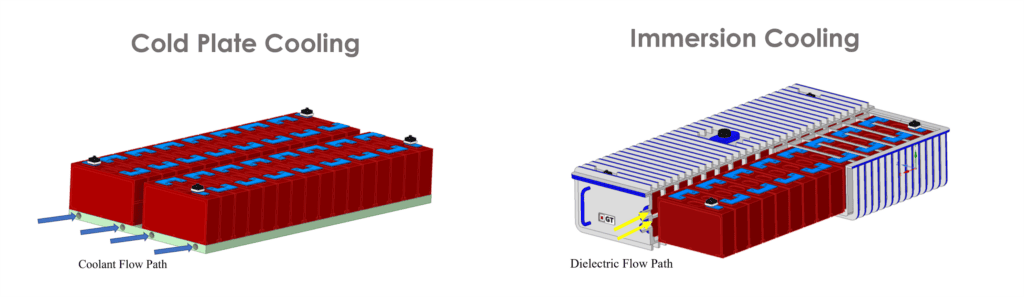
Heat and cooling strategy. High-current cycling generates significant heat, which pushes battery thermal management beyond what simple air cooling can handle. Managing it requires active cooling, such as cold plate cooling or immersion cooling, which increases the cost of the battery pack. A related question is thermal runaway propagation: whether the pack design contains a single-cell failure or allows it to cascade.
Faster battery degradation. Cycling at high C-rates accelerates degradation well beyond what you’d see from calendar aging alone. Physics-based degradation modeling, capturing effects like SEI layer growth, lithium plating, and active material cracking, is what quantifies that impact on the battery’s usable life rather than leaving it to estimate.
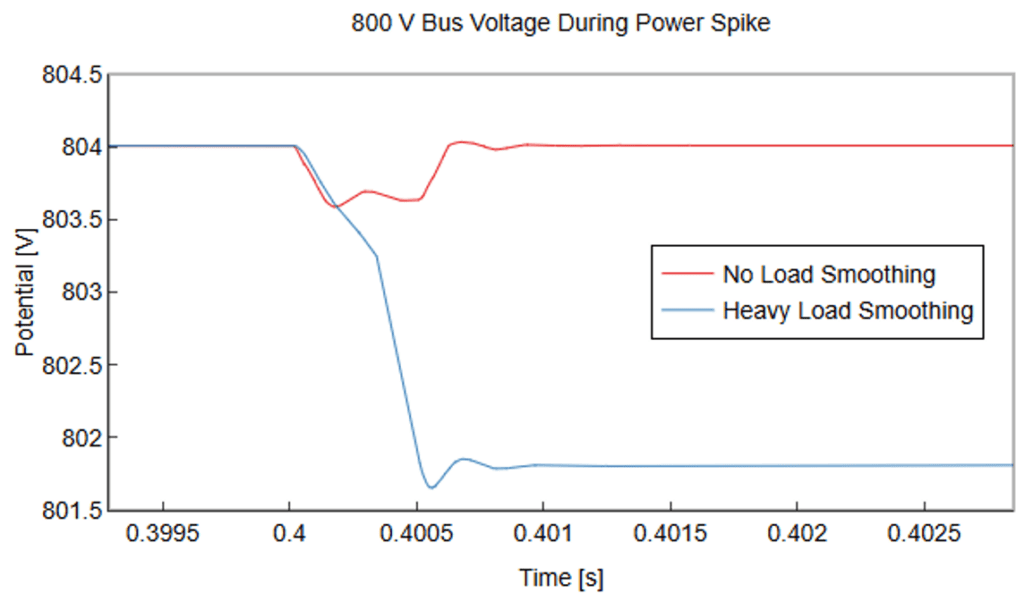
Reduced bus stability. Somewhat counterintuitively, adding the battery made the 800 VDC bus less stable in simulation, not more. The likely mechanism: the battery introduces additional impedance into the system, which adds its own voltage droop and transient behavior during the same 10%-to-100% power swings we care about smoothing out in the first place.
The takeaway
A battery backup unit is valuable for both grid smoothing and outage ride-through, but it isn’t free. Cooling strategy, degradation rate, and bus stability all shift once you add one, and those effects appear only when the electrical and thermal behavior are simulated together rather than treating the battery as an idealized black box.
Part 3 picks up that thread, bringing full thermal management, cooling distribution units and chillers included, into the same model.
Check out our webinar introducing this model or contact us for a live walkthrough and see how this approach could apply to your own facility design!