







Cavitation Prediction
GT-SUITE automatically detects and models cavitation when local pressure drops below the fluid vapor pressure, giving engineers accurate predictions of pump and valve performance under demanding operating conditions.
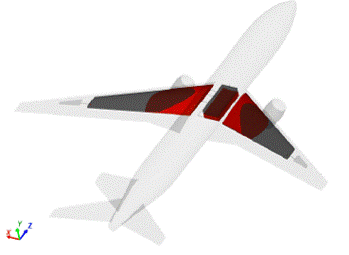
Simulate complete aircraft fuel systems, from 3D CAD to full mission analysis, with accurate predictions of fuel transport, pressurization, venting, and wave dynamics.
Solution Overview
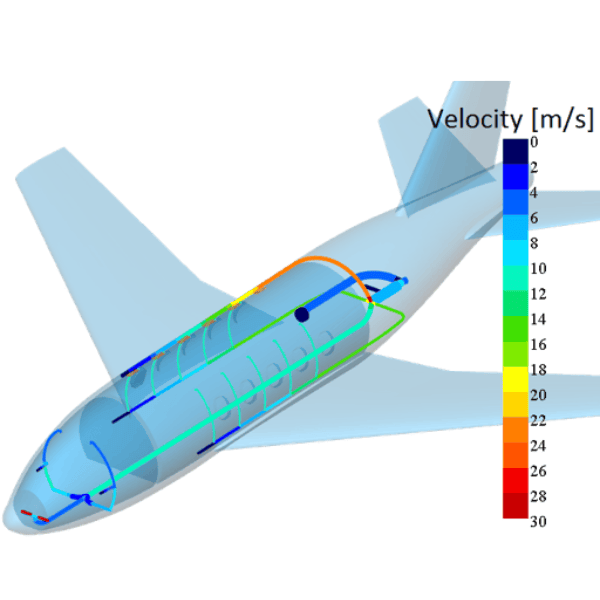
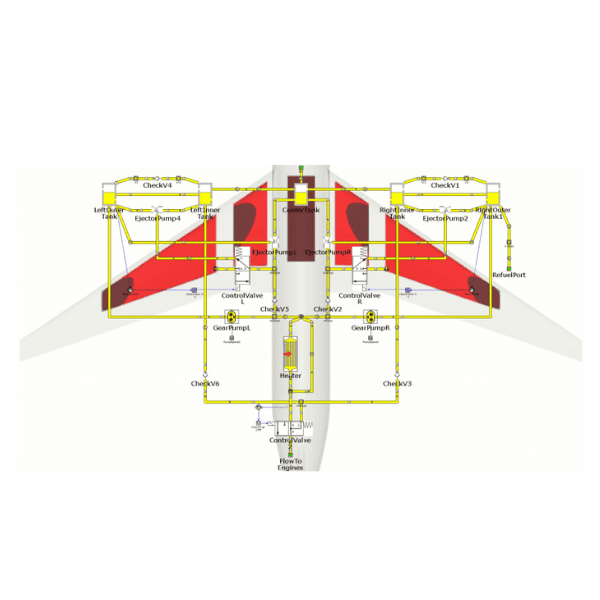
Aircraft fuel systems demand rigorous simulation across a wide range of operating conditions, from ground fueling operations to high-altitude transient maneuvers with six degrees of freedom. GT-SUITE provides a complete 1D simulation environment purpose-built to address this complexity. Engineers use the software to model transient fuel transport, pressurization, distribution, inerting, and heat transfer across the full system, including tanks, pumps, ejectors, valves, and heat exchangers. Models can be built directly from 3D CAD geometry, reducing setup time and improving geometric accuracy. Ambient conditions follow the International Standard Atmosphere model, and aircraft attitude and acceleration inputs allow realistic mission-level analysis.
The platform also supports OBIGGS design through a built-in 3D CFD solver that tracks gas species distribution within fuel tanks, helping engineers verify safe inerting performance before hardware is built. From early concept through detailed design, GT-SUITE gives fuel systems engineers the fidelity and flexibility needed to reduce physical testing, catch design issues earlier, and deliver certified, reliable systems.
GT-SUITE supplies a comprehensive set of component libraries which simulate the physics of fluid flow, thermal, mechanical, electrical, magnetic, chemistry, and controls. From those libraries, one can build fast and accurate models of any type of aircraft fuel system.
What makes GT-SUITE especially powerful is that high-fidelity 3D component models are seamlessly integrated into 1D/0D system-level models, which supply them with accurate transient multi-physics boundary conditions and assure two-way interactions between all of the sub-systems.
Application Highlights
Advanced Features
Analyze fuel transport, thermal management, inerting, and system dynamics under realistic operating conditions.
GT-SUITE automatically detects and models cavitation when local pressure drops below the fluid vapor pressure, giving engineers accurate predictions of pump and valve performance under demanding operating conditions.
The solver tracks free and dissolved gas separately throughout the fuel system, capturing how dissolved air releases as free gas under low-pressure conditions and its effect on fluid properties and wave dynamics.
Vapor and gas species are tracked and transported through the entire system model, ensuring accurate predictions of two-phase flow behavior across all operating conditions.
Learn More
Explore the resources below to learn more about this solution, including technical papers, case studies, and application notes.